
JITTER
Root-cause analysis for on-device ML latency.
When a neural net runs slow on an Android phone, a single benchmark number cannot say why. Jitter reruns the benchmark under four controlled conditions, compares the physical evidence statistically, and delivers the exact diagnosis.
Drop a report. See the evidence.
No cloud telemetry, no uploads. Everything parses in your local browser sandbox. Click any canonical scenario below or drop your own report.json.
mobilenet_v3.tflite
Google Pixel 7 (Tensor G2)
16.4 ms
27.8 ms
44.2°C
28 iters
TAXONOMY OF ON-DEVICE SLOWDOWNS
Six failure modes. Distinct physical causes.
Jitter classifies each benchmark run into one of six mutually exclusive categories based on the evidence collected across the four controlled conditions.
Warmup Drift
First 5-15 iterations take 2-4x longer before suddenly stabilizing.
Shader driver JIT compilation, graph memory allocation, and weights caching into NPU SRAM.
Cold run initial samples exceed steady-state median by >= 3 MAD; CUSUM changepoint detected.
Run warm-up inference iterations in background service before exposing ML model to user interactions.
THE SCIENTIFIC PROTOCOL
Four ways to interrogate a slowdown.
Instead of running one benchmark and reporting a misleading median, Jitter runs four controlled iterations that perturb one physical variable at a time.
The entire diagnostic engine, natively on physical silicon.
No emulators. No cloud proxies. Profile on-device machine learning models directly on Android phones with live SoC thermal telemetry, real NPU/GPU inference graphs, and instant root-cause reports.
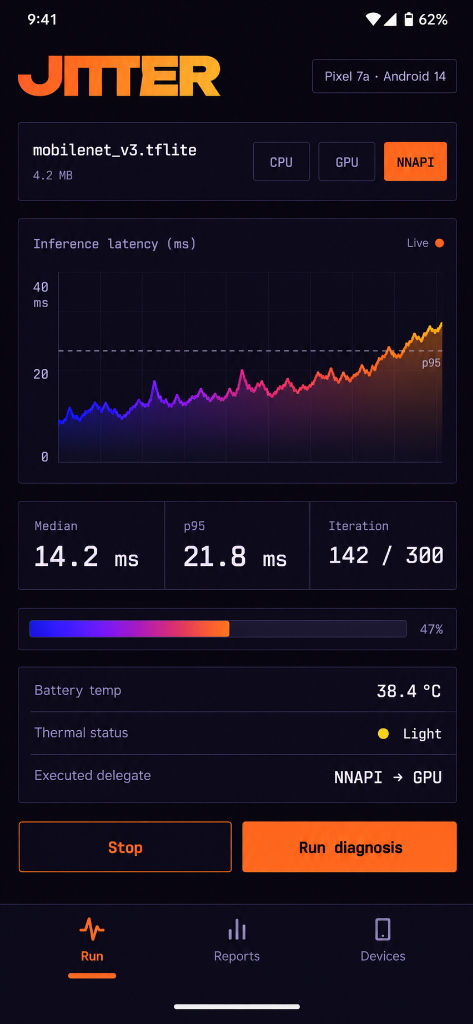
Real-Time Latency Waveforms
Monitors rolling median, p95 jitter spikes, and device battery temperature during continuous LiteRT / TFLite inferences.
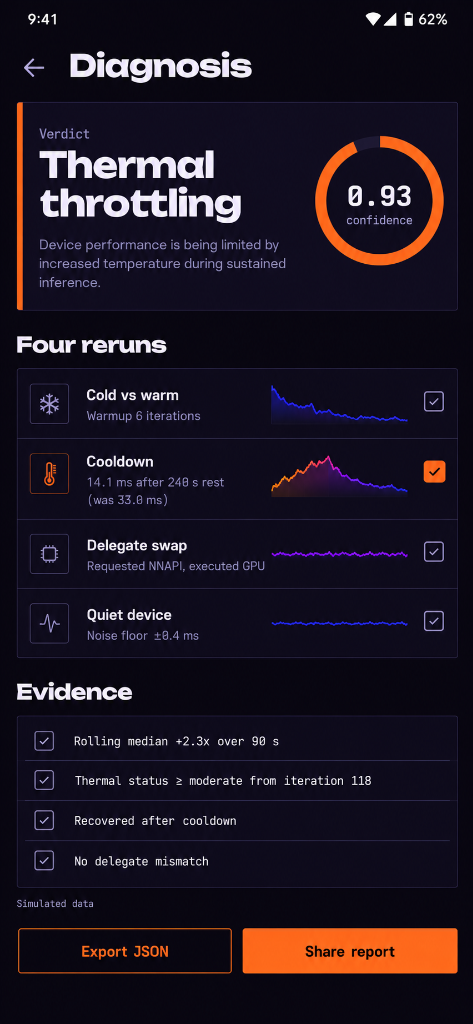
Automated Root-Cause Verdict
Executes cold vs warm, cooldown, delegate swap, and quiet device reruns with an automated confidence score and evidence checklist.
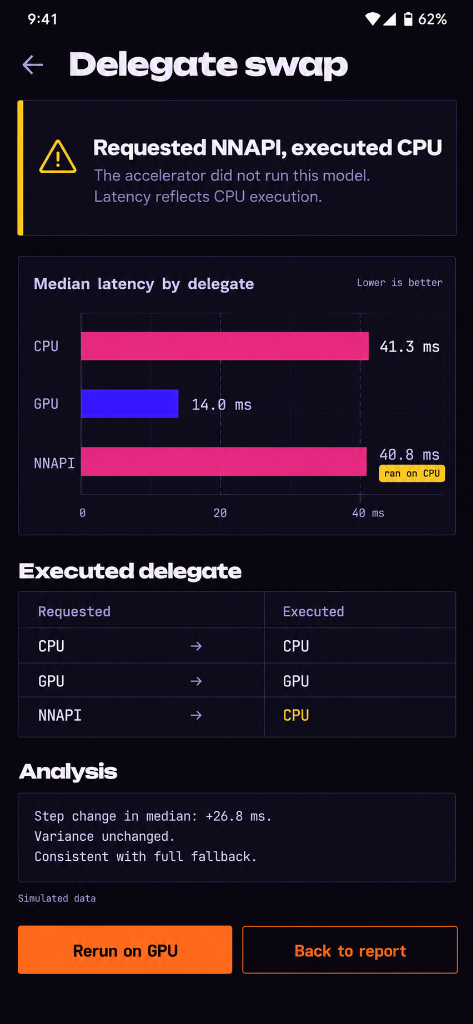
Silent Fallback Detection
Catches silent driver fallbacks from NNAPI/GPU back to CPU, comparing median latency deltas to pinpoint driver incompatibilities.
d7b6603 • SHA-256 verifiedDEVELOPER CLI
Automate diagnostics in your terminal or CI.
+- Verdict: THERMAL_THROTTLING (Confidence: 94.0%) ---------------------------+
| Evidence & Observations:                                                    |
|   + Monotonic latency degradation slope of 0.0242 ms/iter exceeds threshold |
|     0.0200 ms/iter.                                                         |
|   + Device reached thermal throttling status 2 (battery temperature: 44.2°C)|
|   + Rested cooldown run recovered baseline latency (Cliff's delta: 0.81).   |
|   + Ruled out delegate fallback: requested 'gpu' executed on 'gpu' without  |
|     CPU parity.                                                             |
|   + Ruled out background noise: transient bursts absent; quiet mode showed  |
|     no tail latency suppression.                                            |
|   + Ruled out warmup drift: cold startup ratio did not indicate startup delay|
+-----------------------------------------------------------------------------+
HARDWARE PIPELINE
Evidence stays grounded in silicon.
Python CLI & Harness
Typer orchestrator commands, block bootstrap statistics, and diagnosis engine.
ADB Socket Bridge
TCP reverse tunneling over port 8080 with battery & thermal pre-flight checks.
Android Foreground APK
Restful wire protocol server running TFLite/LiteRT with kernel telemetry logging.
Client-Side Dashboard
Zero-cloud local HTML/SVG reports for root-cause inspection and team sharing.